Edible Packaging: Is It Novelty or the Future of Food?
You’ve seen the viral videos of edible water pods and coffee cups. It seems like the ultimate sustainable solution1, but you're skeptical. Is this a real, viable option or just a gimmick?
For now, it's primarily a novelty with future potential. Edible packaging excels in single-serve applications where the wrapper is consumed with the food, but faces significant barriers in food safety2, shelf life3, and production cost4 for widespread use.
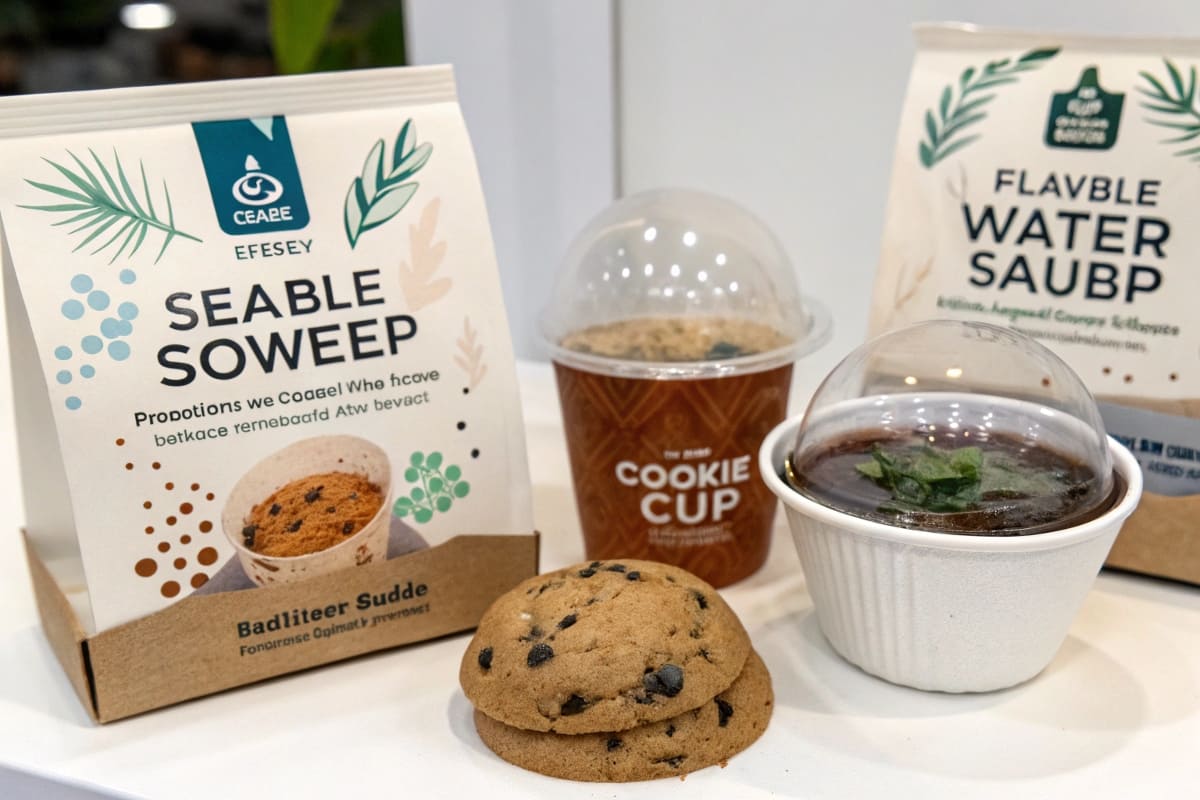
<sup id=](https://whatapackaging.com/wp-content/uploads/2025/10/provide-an-illustration-for-the-following-text-a-20.jpg) 5, such as an edible water bubble, a seaweed-based sauce sachet, and a cookie cup" title="Examples of Novelty and Future Edible Packaging" />
5, such as an edible water bubble, a seaweed-based sauce sachet, and a cookie cup" title="Examples of Novelty and Future Edible Packaging" />
I remember seeing an early prototype of an edible film years ago at a trade show. The idea was to wrap a protein bar in it. The presenter held it up, but their hands were slightly damp, and the film started getting sticky and disintegrating right in front of us. Everyone had a good laugh, but it was a perfect illustration of the challenge: the line between "package" and "food" is incredibly hard to manage. A package needs to be a barrier, but edible things are, by nature, not very good barriers. This fundamental conflict is what we need to solve before edible packaging becomes mainstream.
What Are These Edible Packages Actually Made From?
The idea of eating your wrapper sounds unnatural. You're picturing something with a strange chemical taste or texture, and you’re worried about where the materials even come from.
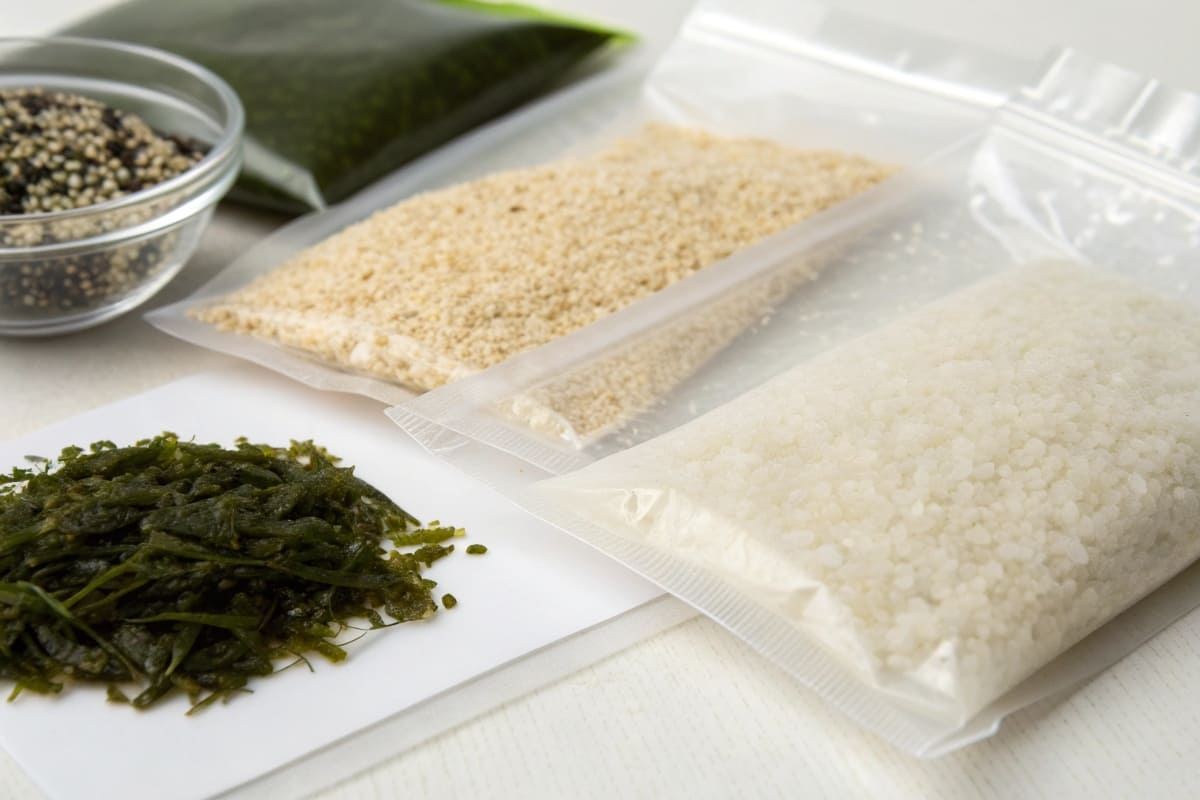
They are typically made from natural, food-grade polymers. Common sources include seaweed extracts6 (like alginate), starches (from potatoes or corn), and even milk proteins (casein), all formed into flavorless films, coatings, or pouches.

Think of it like making fruit leather or pasta dough on an industrial scale. The process involves extracting these natural polymers7, mixing them with a plasticizer (like food-grade glycerin to make them flexible), and then forming them into a desired shape. For example, the company Notpla uses seaweed and other plants to create their famous "Ooho" water bubbles. The seaweed provides the structure, just like wheat flour gives structure to bread. In my factory experience, working with these materials is more like working in a kitchen than a traditional plastics plant. The temperature, humidity, and ingredients have to be just right, or the batch is ruined. It's a precise science, but it's based entirely on familiar, edible ingredients.
Common Types of Edible Packaging Materials
Designers can choose from a growing list of natural sources, each with unique properties.
- Seaweed-Based: Made from extracts like agar and alginate. They form strong, flexible gels, ideal for holding liquids. They are generally tasteless and dissolve easily.
- Starch-Based: Derived from corn, potatoes, or rice. These are great for creating soluble films or pouches, perfect for holding things like instant soup mix or hot chocolate powder. Just drop the whole pouch in hot water.
- Protein-Based: Often made from casein (milk protein) or zein (corn protein). These films are excellent oxygen barrier8s, which can help keep food fresher for longer than some traditional plastics.
| Material Base | Common Form | Best For... | Key Property |
|---|---|---|---|
| Seaweed | Gels, films, pods | Liquid containment, sauce sachets | Dissolves easily |
| Starch | Films, pouches | Dry goods, instant mixes, thin coatings | Soluble in water |
| Protein | Films, coatings | Oxygen-sensitive foods like snacks, cheese | Excellent O2 barrier |
Does Edible Packaging Actually Protect the Food Inside?
Your primary concern as a packaging designer is product integrity. Can a wrapper that's meant to be eaten truly protect food from moisture, oxygen, and contamination during its long journey from factory to shelf?
Its protective capabilities are limited and application-specific. While some protein-based9 films offer good oxygen barriers, most edible materials provide poor protection against moisture, which severely limits a product's shelf life compared to traditional plastics.
This is the billion-dollar question. A standard plastic pouch is designed to be inert and impermeable for months, even years. Edible packaging just can't compete on that level yet. Imagine wrapping a crunchy granola bar in an edible film. That film is designed to dissolve in your mouth, which means it will also readily absorb moisture from the air. In a few days, your crunchy granola bar will be a soggy, unappealing mess. This is why most current applications are for immediate consumption10, like sauce packets served with a meal or water pods at a marathon. The package only needs to do its job for a few hours, not a few months. For a designer like Jacky, this means edible packaging isn't a replacement for a PET pouch; it's a solution for a completely different lifecycle.
The Barrier Problem: A Designer's Challenge
The core function of most packaging is to be a barrier. Edible options struggle here.
- Moisture Barrier: This is the biggest hurdle. Most edible materials are hydrophilic (they attract water), which is the opposite of what you want for keeping dry foods crisp or preventing liquid foods from leaking.
- Oxygen Barrier: Some materials, like casein films, are surprisingly effective at blocking oxygen, which helps prevent foods from going stale or changing flavor. This is a promising area of research.
- Hygiene & Contamination: This is a huge practical issue. An edible wrapper is still food. How do you keep it clean as it's handled by stockers and other customers in a store? This often means the edible package needs its own non-edible outer package, which can defeat the whole purpose.
Is This Technology Scalable and Affordable for Mass Production?
You're intrigued by the concept, but you have to be realistic. Can your company's production lines handle these materials, and can you use them without doubling the product's final price?
Currently, no. Edible packaging is significantly more expensive and slower to produce than conventional plastic. It requires specialized equipment and processes that are not yet optimized for the high-speed, high-volume world of modern food manufacturing.

I run a packaging trading company, so I live and breathe cost-per-unit. A standard plastic pouch might cost a fraction of a cent. An equivalent edible pouch could cost 10 to 50 times that amount. The raw materials are more expensive, and the production process is much slower. Our machines are built to run thousands of plastic units per minute. Edible film production is more delicate and far less automated. Furthermore, a client interested in this tech would need to invest in new machinery to handle it. You can't just feed a sheet of seaweed film into a machine designed for rugged polyethylene. While costs will come down with innovation, for now, edible packaging is a premium, niche solution for brands who can absorb the cost and use it as a powerful marketing story.
The Road to Viability
For edible packaging to move from novelty to norm, several things need to happen.
- Manufacturing Innovation: We need new machinery and processes that can produce edible materials at a speed and consistency comparable to plastics.
- Material Science Breakthroughs: Researchers are working on hybrid materials that improve moisture resistance while remaining safely edible.
- Targeted Applications: The most likely path forward is not a total replacement of plastic, but a focus on areas where it makes the most sense: vending machines, quick-service restaurants, and event catering, where the consumption loop is short and controlled.
Conclusion
Edible packaging presents an exciting glimpse into a zero-waste future11. While it's largely a novelty today, its potential in specific, immediate-consumption niches is real and will continue to grow with innovation.
Learn how edible packaging can reduce waste and promote sustainability in the food industry. ↩
Understand the critical food safety issues that need to be addressed for edible packaging to succeed. ↩
Discover the impact of edible packaging on food shelf life and its implications for consumers. ↩
Get insights into the costs involved in producing edible packaging and its economic viability. ↩
Explore the advantages of edible packaging and its potential to revolutionize sustainability in food. ↩
Learn about the role of seaweed extracts in creating innovative edible packaging solutions. ↩
Explore the types of natural polymers that make edible packaging possible and their benefits. ↩
Learn about the effectiveness of edible materials in blocking oxygen and preserving food. ↩
Discover how protein-based films enhance the functionality of edible packaging. ↩
Understand the significance of immediate consumption in the context of edible packaging. ↩
Explore how edible packaging can play a role in achieving a sustainable, zero-waste future. ↩